Tufte’s theory of Layering and separation is one not often obvious found within food advertisements, as it is hugely important for the visual elements to be more prominent. Tufte explains in Envisioning Information (1990) that each individual layer within an image must work alongside the layers surrounding itself in order to create and maintain stability for the design as a whole. He provides an example from a manual for a copier which has over 300 individual parts, and uses colour and clear layers to show the consumer what is happening within the image which in turn allows them the understand as stated by Tufte, “Confusion and clutter are failures of design, not attributes of information.”
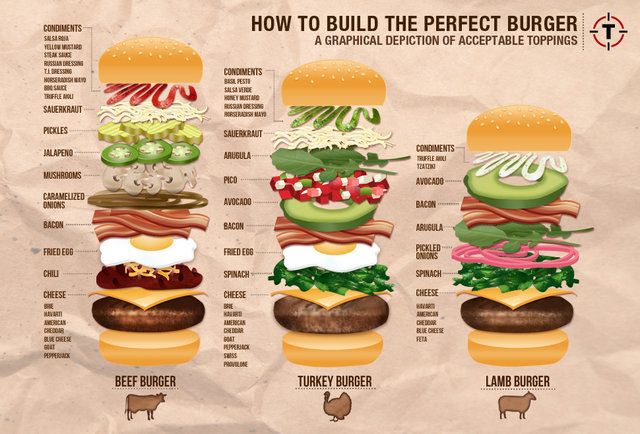
I have found an example similar to that of Tufte, nowhere near as intricate – however the basic concept is still observable. In the example, it shows three types of burger and how to ‘build the perfect’ one. Each burger is clearly separate from the other two shown by the silhouettes on the animal below and by the use of ‘white space’. Each ingredient is also very clearly labelled and placed alongside dotted lines which the consumer can easily follow, this allows them to understand much easier – fulfilling the designers brief to show potential customers how ‘simple’ it is to create the huge burgers which you find in restaurants in their own home. Alongside the ingredients, alternatives can also be seen. For example, below ‘cheese’ is the options for other cheeses such as blue and feta. The use of this within the advertisement shows the customer that they have their own control and psychologically they will be more inclined to follow the advertisement.
Bibliography:
Gentile, D. 2013. How to build the perfect burger: a graphical depiction of acceptable toppings. Thrillist. Available online: https://www.thrillist.com/eat/nation/how-to-build-the-perfect-burger-a-graphical-depiction-of-acceptable-toppings. [Accessed 14/11/21]
Tufte, E. (1990). Envisioning information.